Written and medically reviewed by: Dr.Prratyush More, MBBS, DDVL | Pristine Radiance,Thane
Underarms are one of the most commonly treated areas for laser hair reduction, and one of the areas that tends to respond well. Still, the number of sessions varies a lot from person to person. Here is what decides it, based on how lasers and hair growth actually work.
| In brief
• Many people need around six to eight sessions for the underarms, usually spaced four to six weeks apart. Some need fewer, some need more. • Laser treatment gives long-term hair reduction, not permanent removal. Indian dermatology guidelines recommend describing it this way. • Hair colour and thickness, skin tone, hormones, and what you do between sessions all affect how many sessions you need. • Some people need occasional maintenance sessions later. |
How laser hair reduction works
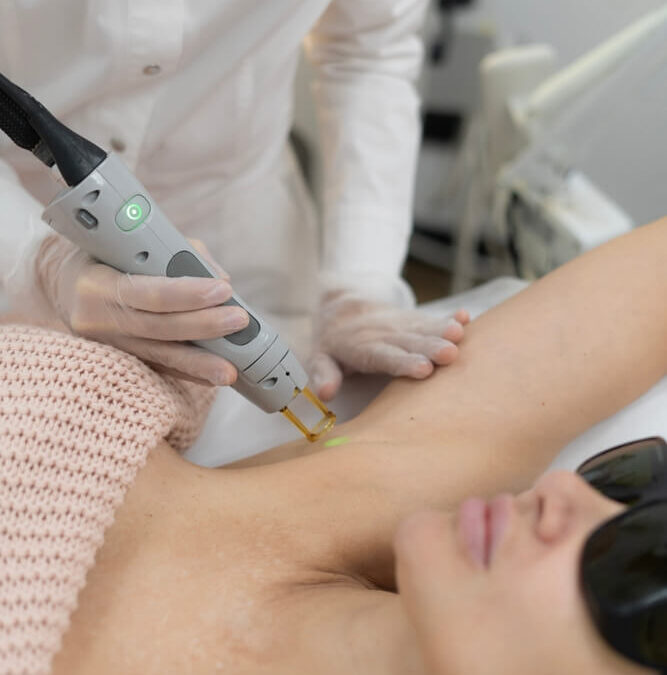
Laser hair reduction is based on a principle called selective photothermolysis. The laser’s light is absorbed mainly by melanin, the dark pigment in the hair shaft and hair bulb. The light turns into heat, which travels down the hair and damages the parts of the follicle that produce new hair, while the surrounding skin is relatively spared.
Two facts follow from this, and they explain most questions about sessions:
- The laser works best on hairs in the active growth phase (anagen), when the hair is attached to the pigmented bulb. At any one time, only a portion of hairs in an area are in this phase. Others are resting or shedding and are less affected. Several sessions are needed to catch each follicle while it is growing.
- The laser needs contrast between dark hair and lighter skin. Darker skin also contains melanin and absorbs some of the energy. In darker skin, settings must be adjusted to protect the skin, which can mean more sessions.
Why underarms often respond well
Underarm hair is usually dark, coarse and dense, which gives the laser plenty of melanin to target. That is why many people notice a clear reduction after the first few sessions. In many Indian patients, however, the underarm skin itself is darker than the surrounding skin, which needs careful setting of the laser energy.
A typical course
- Sessions are usually four to six weeks apart for the underarms, timed to catch the next group of hairs entering the growth phase.
- After each session, treated hairs typically shed over one to three weeks. Hair that seems to “grow” in the first week or two is usually treated hair being pushed out, not new growth.
- Regrowth becomes progressively finer, lighter and sparser over the course.
- Many people need six to eight sessions, and some need more. The Indian standard guidelines on laser hair reduction advise that patients be told multiple sessions are needed and that maintenance may be required later.
Why some people need more sessions
1. Hair colour and thickness
Fine, light-brown, red, grey or white hairs contain little melanin, so the laser has less to target. Grey and white hairs generally do not respond to laser at all. Thick, dark hairs respond best.
2. Skin tone and tan
Most Indian skin falls between Fitzpatrick types III and V. Longer-wavelength lasers such as diode and Nd:YAG lasers, used with appropriate settings and skin cooling, are generally safer for darker skin. Conservative settings protect the skin but may mean more sessions. A recent tan has the same effect, which is why avoiding sun before treatment matters.
3. Hormones
Hormones influence how much hair grows and how thick it becomes. Conditions such as polycystic ovary syndrome (PCOS), thyroid disorders and insulin resistance, as well as some medicines, can stimulate new hair growth even after successful sessions. Indian guidelines recommend that women with excess hair growth be evaluated for an underlying cause. Treating the cause improves the long-term result.
4. What you do between sessions
Waxing, threading and plucking remove the hair along with its root, which leaves nothing for the laser to target at the next session. Shaving or trimming is the recommended method between sessions, because the root stays in place.
5. Timing and consistency
Sessions too close together may treat mostly resting hairs; long gaps let more hairs complete their cycle untreated. Following the schedule your clinician recommends makes a real difference.
6. Device, settings and operator
The type of laser, the energy used, the cooling and the technique all influence results. Indian guidelines advise that laser hair reduction be carried out by a trained dermatologist, or by trained staff under a dermatologist’s direct supervision.
How to get the most from each session
- Shave the area the day before, as advised by your clinic.
- Do not wax, thread, pluck or use bleaching creams once you start the course.
- Avoid tanning and protect the skin from sun in the weeks before and after treatment.
- Tell your clinician about all medicines and supplements, as some increase light sensitivity.
- Avoid deodorants, perfumes and scrubs on treated skin for the period your clinician advises, as the skin may be sensitive.
- Keep to your recommended schedule.
Possible side effects
Temporary redness and small bumps around the follicles are common for a few hours to a couple of days. Less commonly, people may experience blistering, crusting, darkening or lightening of the skin. These are usually temporary but should be reported to your clinician. Rarely, laser can stimulate new hair growth in nearby areas, a condition called paradoxical hypertrichosis.
Important note
This article is for general health education only. It is not a substitute for an in-person consultation, diagnosis or treatment. The suitability and results of any treatment vary from person to person, and no treatment can promise a particular outcome. Please consult a qualified Registered Medical Practitioner about your own situation.
References
- Buddhadev RM. Standard guidelines of care: laser and IPL hair reduction. Indian J Dermatol Venereol Leprol. 2008;74(Suppl):S68–S74.
- Anderson RR, Parrish JA. Selective photothermolysis: precise microsurgery by selective absorption of pulsed radiation. Science. 1983;220(4596):524–527.
- Gan SD, Graber EM. Laser hair removal: a review. Dermatol Surg. 2013;39(6):823–838.
- Haedersdal M, Wulf HC. Evidence-based review of hair removal using lasers and light sources. J Eur Acad Dermatol Venereol. 2006;20(1):9–20.
- Lim SPR, Lanigan SW. A review of the adverse effects of laser hair removal. Lasers Med Sci. 2006;21(3):121–125.